
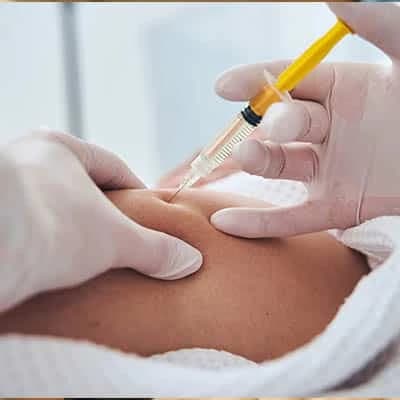
1. A cell has a boundary
A fat cell is enclosed by a membrane. Laboratory work by Rotunda and colleagues investigated how sodium deoxycholate affects that boundary. In the studied cells and tissue, the detergent action disrupted membranes and reduced cell survival. This was mechanism research, not a clinical trial of the current Leeds service.
Think of a diagram of this process as an explanation of a concept. It cannot show an individual's anatomy, tell a practitioner where to inject or predict how much a contour will change. The useful distinction is between describing a biological action and proving a safe, effective treatment plan for a particular person.
Evidence: Rotunda et al. (2004) — Detergent effects of sodium deoxycholate
- 01 / INTACT
An intact fat cell
A thin membrane encloses a large lipid droplet.
- 02 / DISRUPTION
Membrane disruption
Deoxycholate can disrupt cell membranes, releasing their contents.
- 03 / PROCESSING
Gradual processing
The body processes released material over time. This is not an instant change.
2. Cell disruption is not ordinary fat burning
In this context, the intended action is damage to cells in the treated tissue. It is not a claim that the product accelerates the normal whole-body use of fat for energy. Laboratory findings also show that detergent effects are not automatically selective for fat cells, which is one reason the product and administration technique matter.
A simple phrase such as melts fat can hide those distinctions. It should not be used to imply a harmless process, an instant change or a treatment that improves general health. No dose, injection depth or self-treatment instructions are provided here.
Evidence: Rotunda et al. (2004) — Detergent effects of sodium deoxycholate
3. The tissue response takes place over time
Research into phosphatidylcholine/deoxycholate injections has observed cell injury and an inflammatory response involving macrophages, immune cells that help deal with damaged tissue. That research used a different formulation; it provides background biology rather than proof of a particular Aqualyx result or recovery time.
An early change in how an area looks or feels should therefore not be equated with the finished cosmetic result. Clinical review considers recovery, the intended goal and any complications together. More swelling is not a reliable sign of a better result, and a dramatic immediate photograph is not a substitute for a properly timed assessment.
4. Ingredient names do not establish the current product
Historical Aqualyx literature describes a deoxycholate-derived formulation without phosphatidylcholine. Published descriptions of ingredients and concentrations are not a specification for the stock used at Leeds today. We do not present an unverified percentage formula as definitive patient information.
The current Marllor Aqualyx Cosmetic webpage is labelled for topical use. It must not be treated as instructions for an injection. The practitioner must use the instructions applicable to the actual injectable product and assess the proposed plan. No current formula, injection dose or authorised indication is inferred from the topical webpage.
Evidence: Amore et al. (2016) — Intralipotherapy, the State of the ArtMarllor Biomedical — Aqualyx Cosmetic
What this science can — and cannot — tell you
A mechanism helps explain why an approach is being investigated. It does not, by itself, establish which body areas are suitable, how many sessions you need, what risks apply to you or how much change you will see. Those are separate clinical questions, requiring the right evidence and an individual assessment.
At consultation, connect the science to your decision: ask which product is proposed, why it is appropriate for your concern, what evidence supports that use and what alternatives are reasonable. The safety, suitability and results pages address those decisions without treating a scientific diagram as a promise.
Your questions, answered
Does fat leave the body immediately after an injection?
No immediate-result promise is supported here. Cell injury and tissue response are processes, and appearance must be assessed through recovery and follow-up rather than from an instant photograph.
Is Aqualyx Cosmetic proof that injection is authorised?
No. The current manufacturer page specifies topical application. It does not establish the instructions or regulatory status of the injectable product used at Leeds. Ask contact@vivobodystudio.com about the proposed treatment.
Can the same science prove every body area is suitable?
No. A general mechanism is not evidence for a particular product, anatomical site, technique or patient.
Sources & editorial review
VIVO Body Studio editorial team. Updated 26 October 2026. VIVO’s owner confirms review by the Leeds practitioner. This is an owner-reported review, not an independent clinical certification. Published evidence and individual treatment advice are distinguished below.
- Rotunda et al. (2004) — Detergent effects of sodium deoxycholate ↗
Primary cell-culture and porcine-tissue mechanism research. Not an Aqualyx Leeds clinical outcome study.
- Reeds et al. (2013) — Metabolic and Structural Effects of Phosphatidylcholine and Deoxycholate Injections ↗
Primary research using a PC/DC formulation, not the current Aqualyx Leeds stock. Used only for limited background on tissue response.
- Amore et al. (2016) — Intralipotherapy, the State of the Art ↗
Historical clinical report; most authors disclosed advisory/training relationships with Aqualyx distributors. Product description and protocols are not current Leeds authorisation.
- Marllor Biomedical — Aqualyx Cosmetic ↗
Checked 26 October 2026. This current page specifies topical application only; it is not an injectable IFU or proof of Leeds injection authorisation.